Ayahuasca: used for centuries
The traditional use of ayahuasca has been known to many Amazonian societies for centuries, with the earliest evidence of ceremonies dating back around 1,000 years. Here, we present a few key points to help you better understand what ayahuasca is.
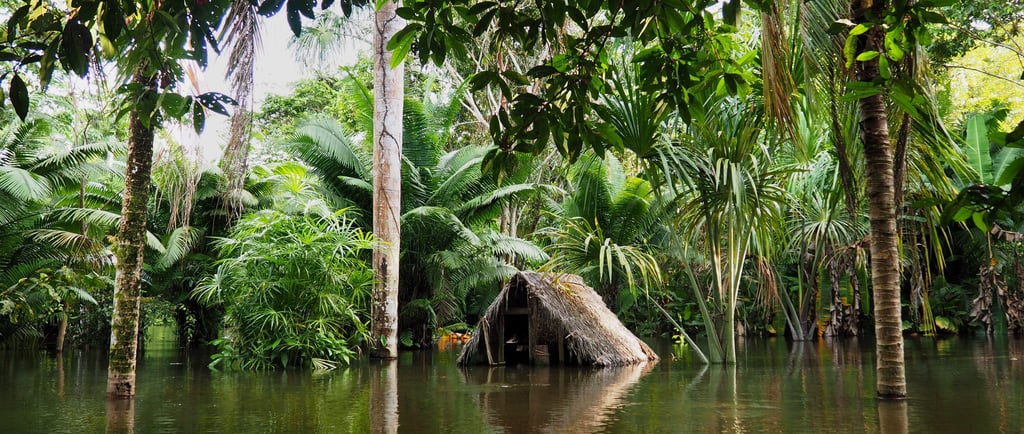
The Amazon is recognised as the lungs of the planet because of its unrivalled biodiversity. Covering 5.5 million square metres, it accounts for half of the Earth's tropical forests. It is therefore easy to understand why the plant world takes a central place in the culture of the Amazonian peoples, who have lived in this giant ecosystem since their origins. Over the centuries, they have developed their own medicinal strategies based on lands rich in active ingredients and substances with therapeutic properties.
Ayahuasca is both a plant and a traditionally prepared beverage used in ritual settings to treat various physical, psychological, psychosomatic, and emotional disorders. It is also consumed for more spiritual purposes and to explore altered states of consciousness, particularly through dreamlike experiences. In Amazonian societies, ayahuasca ceremonies are among the oldest shamanic medicinal practices (between 1,000 and 2,000 years old). The term ayahuasca means “vine of the dead” in Quechua (aya: death, spirit; huaska: rope, vine). Depending on the people who use it, ayahuasca has different names: Avireri (god of the forest) for the Ashaninka of Peru, Yajé (or yagué) for the Tukano of Colombia, Caapi for the Tupi-Guarani of Brazil, and Nishi Oni or Oni for the Shipibo.
Each name is accompanied by a myth explaining how the plant was discovered by the people, but all mythologies agree that ayahuasca is the “spirit of all spirits,” the mother plant that teaches initiates.
Scientific point
The psychotropic effects it produces are the result of a chemical reaction between two plants containing powerful alkaloids: the bark of the ayahuasca vine (Banisteriopsis caapi) from the Malpighiaceae family contains beta-carbolines (harmaline and harmine), and the leaves of chacruna (Psychotria viridis, Rubiaceae) contain DMT (dimethyltryptamine, N-dimethyltryptamine), a psychotropic substance. When consumed alone, DMT has no effect on the body, thanks to the action of MAO enzymes (monoamine oxidases, MAO-A and MAO-B) located in the intestines, which break it down before it enters the bloodstream. MAO acts as a safety barrier to prevent the absorption of dangerous amino acids (e.g., tyramine stored in certain aged cheeses). When MAO is inhibited (blocked), DMT can circulate freely in the bloodstream. The duration of inhibition can vary depending on whether the inhibiting agent is reversible or not: an MAOI (MAO inhibitor), such as certain antidepressant drugs, can act for days or even weeks, while an IRMAO (reversible MAO inhibitor) only works for a few hours: this is the case with ayahuasca alkaloids. By inhibiting MAO, it temporarily activates the DMT contained in chacruna. This is the chemical cause of the visions generated and the changes in consciousness.
Amazonian societies have acquired knowledge of the molecular composition of these two plants, achieving a perfect dosage. Some would say that they acquired this knowledge directly through ingesting hallucinogenic plants.
Cultural Heritage of the Nation in Peru
It was not until 2008 that ayahuasca was declared cultural heritage of the nation in Peru (National Resolution No. 836/INC of June 24, 2008). The Ministry of Culture states that “the practice of ritual ayahuasca sessions is one of the fundamental pillars of the identity of the Amazonian peoples and that their ancestral use in traditional rituals, ensuring cultural continuity, is linked to the therapeutic virtues of the plant.” In other traditional societies, plants whose use is just as ancient serve the same dual medicinal and cultural purpose. For example, among the Samoans of the Western Pacific, kava is a sacred medicinal plant that has been used for thousands of years. The same is true of iboga (Tarbernanthe iboga), used in the Bwiti ritual in Gabon, Syrian rue (Peganum harmala) in Asia, Virola (Virola caloPhylla) among the Yekwanas of Venezuela, and fly agaric (Amanita muscaria), which grows in the northern hemisphere.
The role of the shaman*: Why is it important to be accompanied during an ayahuasca ceremony?
On the one hand, it takes years of training and practice to be qualified to lead ayahuasca ceremonies, hence the importance of being properly guided to the right initiated person. Psychotropic plants have powerful medicinal properties only when taken in a traditional context. This does not mean that the active ingredient is nullified when an initiated person does not lead the ceremony. However, the sacred remains the element that ensures the effectiveness of the desired medicinal properties, since these are revealed and controlled by the guide during the ritual. Moreover, many shamans emphasize that what is fundamental is the intention behind the healing.
On the other hand, the initiated person will have previously diagnosed your mental and physical state and will judge whether you are suitable for the ceremony. However, under no circumstances does an ayahuasca ritual replace a consultation with a general practitioner or specialist.
The role of the shaman and the traditional context in which ayahuasca is consumed are two important elements. Resolution No. 836/INC explains that it is “a wise or master plant that teaches initiates the very foundations of the world and its components.” It adds:
“The effects of its consumption constitute entry into a spiritual world and its secrets, which is why traditional Amazonian medicine has been structured around the Ayahuasca ritual (...) and [is] indispensable for those who assume the role of privileged holders of these peoples' cultures (...)”.
“The effects produced by Ayahuasca (...) are different from those usually produced by hallucinogens. Part of this difference lies in the ritual that accompanies its consumption, which leads to various effects, but always within a culturally defined margin.”
*healer, facilitator, medicine woman/man
Sources:
BERLIN B. (1992). Ethnobiological Classification Principles of Categorization of Plants and Animals in Traditional Societies. Princeton University Press
ITURRIAGA SAN JOSE A. & RIVERA CACHIQUE R. (2016). Ayahuasca de la selva su espiritu: Tecnica aborigen del autoconocimiento (2ème édition). Cusco : Rumi éditions E.I.R.L
NARBY J. (1995). Le serpent cosmique. L’AND et les origines du savoir. Éditions Georg
SCHULTES R. E. (1978). Atlas des plantes hallucinogènes. Éditions de l’Aurore
TOURNON J. (2002). La Merma mágica. Vida e historia de los Shipibo-Conibo del Ucayali, Lima, Centro amazónico de antropología y aplicación práctica (CAAAP), cartes, tabl., fig., 8 pl. hors texte
Résolution directoriale nationale n°836/INC (RDN) du 24 juin 2008, Déclaration du patrimoine culturel de la nation aux savoirs et usages traditionnels de l'Ayahuasca pratiqués par les communautés autochtones amazoniennes.
http://administrativos.cultura.gob.pe/intranet/dpcn/consulta.jsp?pagina=20